
Bless This Mess
1,784 miles, ten days and reflections on America at 250.

People didn’t really seem all that into America 250, to be honest. The President was making it all about himself, and that instantly politicized it. The Reflecting Pool turned green. No one wanted to play in his concert. The Great American State Fair seemed like a really good idea, but I thought it was supposed to be in Iowa and not sterile, manicured, and perfectly placed on the National Mall in D.C. (Also, as has been pointed out across the internet: Is there any fried food at this so-called State Fair? If the answer is no, then they’ve done it wrong.)
People didn’t seem to be about it. And who could blame them? The price of gas, the cost of living, the slow-motion chaos machine that is our politics currently— it’s easy to want nothing to do with America right now. Before I left on vacation, brands were trying. Patriotic everything was flooding the shelves. Budweiser, always good at putting Americana on display, showed up with a good, solid ad that made you want to throw some hot dogs on a grill and crack a beer.
But in general, gloom, doom, and a general shrug of the shoulders were the order of the day. America seemed largely indifferent to 250 years, and then something weird happened: the World Cup began.
The Internet is a weird thing because it manages to simultaneously hand everyone the sum of all human knowledge at the click of a button and impose blinders on everyone who uses it, narrowing our field of vision to whatever the algorithm requires. But that blinds us to just how big America really is— and the World Cup of all things provided one hell of a reminder that America is far bigger than what we doom scroll through daily. America is bigger than what is packaged, sorted, and beamed into our eyeballs.
Lawrence, Kansas, hosted the Algerian National Team and just, well, adopted them as their hometown team. The KU Marching Band learned the National Anthem. Cheerful Midwesterners loudly proclaimed ‘Rock, Chalk, Algeria.’ Scotland’s Tartan Army just about drank Boston dry. Multiple foreigners were astonished at Buccee’s, New Orleans, the music of Ella Langley- take your pick. America surprised them because it wasn’t what the internet told them it was. It was a hell of a lot bigger than that.
America is big. Really, really big. So we did what parents do every summer and immediately regret: we loaded up four kids and hopped a flight to California, rented a car, and spent the next ten days seeing America.
I. California
The first time I went to California, I was in high school. I had an unfortunate middle part (as was common in the mid-to-late 90s) and thought that summer was a good idea to take two different colors of Manic Panic and use them to dye one side of my hair electric blue and the other hot pink.1
I was young. I dyed my hair a lot. Until my Uncle, who was a Capitol P Punk back in the 80s (like the kind who hid in toilets after a concert to avoid getting the shit kicked out of him by actual skinheads type of punk) pointed out that he used to dye his hair a lot, and now he was bald. Message received, though the retreat of my hairline now, I think, has more to do with having four boys than any lingering chemical afterburn from multiple uses of hair dye.
We went to Tahoe, Yosemite, San Francisco, up into Napa, and then home on that trip.
This trip began in Los Angeles, where the thought of spending ten days in a Hyundai Santa Fe with four boys ranging from 5 to 14 was something that both the Missus and I had immediate second thoughts about.
But we rallied through it. One night in LA, we were going to see the Hollywood sign! We were going to take these boys to the ocean!
And boy howdy, did I forget how freaking big Los Angeles actually is.
I have the Midwestern Driving Disease. You look at a map, do some mental math in your head, and decide that ten hours in a car really isn’t that much after all. I look at Minneapolis and Saint Paul and then Dallas and Fort Worth and think, that’s got to work the same way, right? You're just driving from one to the other, crossing the river, and bam, you’re in Saint Paul or Minneapolis, depending on which way you’re driving.
Then I went to Dallas and discovered that driving to Fort Worth is a little like driving to the moon. It’s not right next door; it just looks like it is. It’s sneaky. It’ll fool you.
Driving in Los Angeles is much the same way.
We landed in Burbank. Allegiant does save you money on airfare, but they fly into airports that seem to be designed for 1960s levels of pedestrian traffic. It felt a little like Ciampino in Rome, minus the carabinieri with the big guns. Our hotel was in North Hollywood. I was disappointed not to be greeted by a Blue State Dystopian Hellscape that the Internet Promised. Snake Plissken did not meet us at the rental car center, advising us to head in the other direction. At no point did anyone offer us any free fentanyl. I could probably count on both hands the number of unhoused folks I actually saw just driving from point A to point B.
Do the parts look a little shabby and worn around the edges? Yes. We were definitely not staying in the shiny gated elite areas of the city, and that’s fine. It looks like any other large city in the world— and that’s the secret they don’t tell you when they’re screaming at you about chaos in the ‘Blue Cities.’ They’ve never been there. They don’t live there. They’re screaming at people who would rather lose a finger in a corn thresher than actually spend their vacation in Los Angeles, even if just for one night.
Do the actual people who live in these cities have some actual valid complaints? Undoubtedly. But the people screaming about it on the internet, by and large, don’t live there and don’t care. They’re grifting for political points. So, don’t let internet grifters scare you away from any part of America. Don’t trust them. If you’re honestly curious and want to visit a place like Los Angeles, go and see for yourselves. Draw your own conclusions. (Common sense in any large city will serve you well: try not to be out after midnight, be aware of your surroundings, well-lit areas, etc. No one is immune to bad things happening to them, but this isn’t hard.)
My conclusions remain more or less unchanged from my prior visit: the place is too goddamn big, it takes forever to get anywhere, and it’s almost completely its own dimension2. (My first visit, there were an astonishing number of Hummers on the expressways as well as pick-up trucks that should be rehomed to a ranch in South Dakota. Utterly preposterous for a city like Los Angeles. This time, there were no Hummers, but the pick-up trucks were still holding strong.)
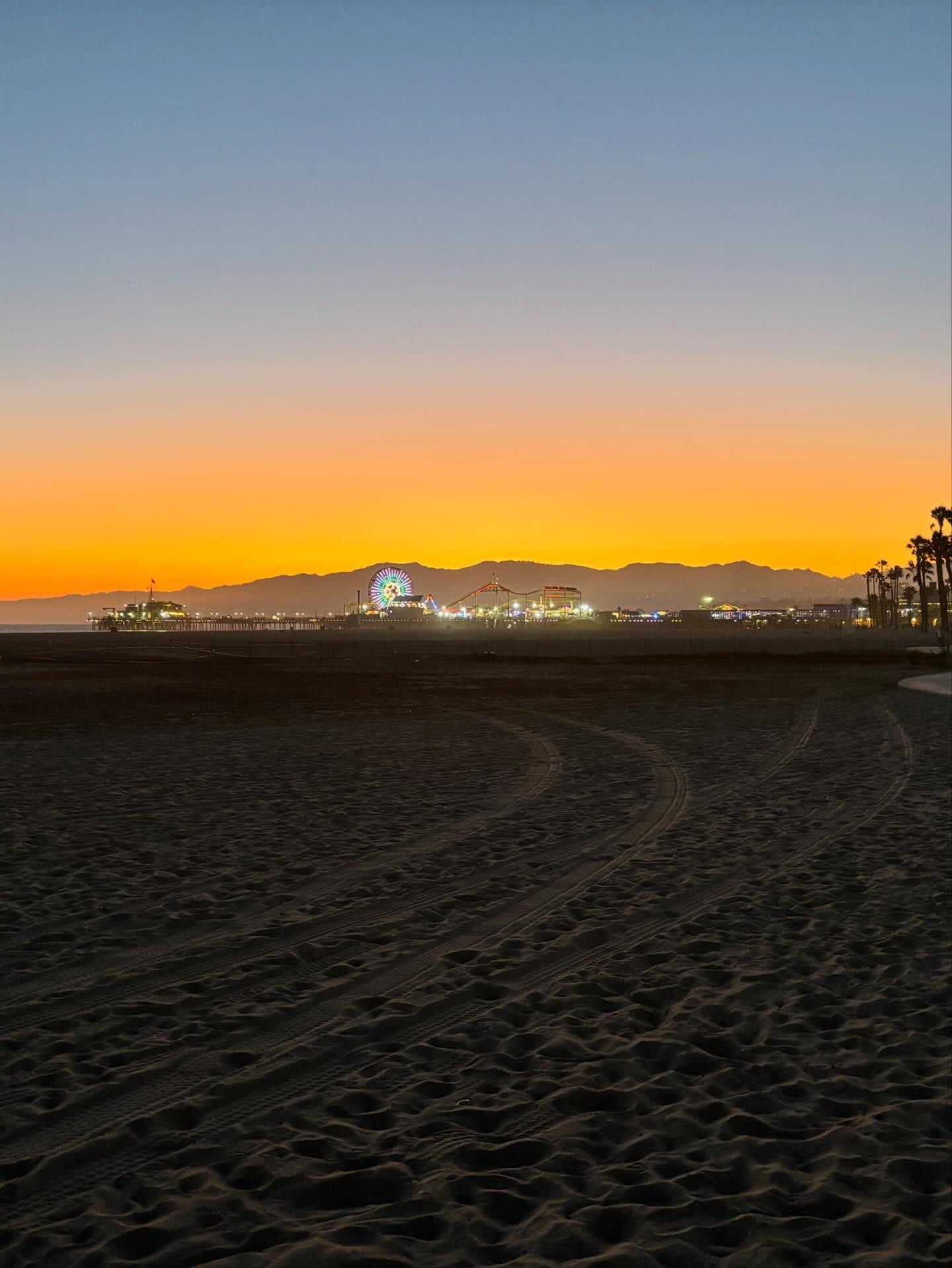
But we did it. We fought the tourists and influencers and saw the Hollywood sign. We traversed the metropolis to Santa Monica and saw the Pacific. (It always seems to be freezing cold whenever I see the Pacific. Three times I’ve seen the damn thing, and I’ve damn near frozen every time.) We ate at Bubba Gump Shrimp Company on the Pier (honestly, the worst culinary experience of the entire trip, to be honest) and somehow made our way back to North Hollywood and the hotel. We were on our way.
II. Sequoia
The thing about National Parks that I forget sometimes is that reaching the entrance gate doesn’t necessarily mean you’ve reached your destination. Far from it, in fact— thus it was with Sequoia National Park.
We left Los Angeles and headed north. The sprawling mess of a metropolis faded behind us into mountain passes that eventually led us down and out into California's Central Valley. I remember vaguely driving from Yosemite to San Fransicso across the northern end of the Central Valley in high school, but to be honest, I didn’t pay much attention at the time. (I have a very vivid memory of hills of golden grass waving in the breeze off the coast as we got closer and closer to San Francisco, and then suddenly, we were there.)
This time it was different. I think the current environmental situation in Iowa makes me more curious about the differences in agriculture in other states. I’ll be honest, though: I’m a city boy, so I’m still learning. (The Missus had a more country-based childhood than I did, so she’s got some more game in this area than I do.) On the way to Bakersfield, we found fruit. And it was fascinating, driving through the fruit belt of California— what’s the tree? What’s the tree? Are those oranges? Lemons? Grapefruit? Cherries? It was so crazy, just the sheer amount of fruit and a frustrating reminder of the sad state of Iowa’s monobrained agriculture. We were so fascinated, we took a brief detour at Bakersfield to check out the California Fruit Depot and got the freshest citrus imaginable (and some truly amazing Pink Grapefruit Marmalade).
We did the requisite stop at In-N-Out Burger (because when you’re out west, you kind of have to check it off the list— if you haven’t had a chance to, for whatever reason, you should) and kept heading north, off the beaten path a little bit, heading for Three Rivers, California, and Sequoia National Park.
Somewhere north of Bakersfield, we drove through an intersection that featured Merle Haggard Boulevard, and that’s when I learned something on my vacation: Merle Haggard, a country music legend and someone I had previously just assumed was from Muskogee, Oklahoma, was, in fact, from California. Now, granted, I can name you two Merle Haggard songs, so perhaps I’m not the best person for biographical information on country music legends.
But on the other hand, it’s Merle Haggard- everyone has probably been in a dive bar or a honky tonk somewhere and heard Okie from Muskogee and drawn the obvious conclusion. Dude is from Oklahoma, because why on Earth would you think anything else? But no, he’s from California, and a stroll through his Wikipedia page reveals that he is very definitely from California. He died in California. He committed crimes and did prison time in California. He was pardoned for his crimes by then-Governor Ronald Reagan. He’s that California. (Now granted, his family did the whole ‘Grapes of Wrath’ thing and migrated out to California after their farm in Oklahoma burned down, so it’s not an atypical story, from a historical point of view. But still… of all the places you could have told me that Merle Haggard was born in, Oildale, California would have been very low on the list.)
We kept driving north and eventually reached our destination of Sequoia National Park.
Now, you may ask, other than general craziness on the part of The Missus and me, why so many National Parks? I mean, yes, National Parks are America’s best idea and should be fully funded and defended, and every American should go visit as many of them as possible, because they’re amazing, but this time, we had reasons and, more specifically, a 4th Grader.
The Ten-Year-Old (hereafter known as Ten) is not the best friend to nature. Not an outside kind of kid. Not a hiker. But he was in 4th Grade this year, and that meant we could take advantage of this excellent program, Every Kid Outdoors, that gives 4th Graders and the folks accompanying them free admission to National Parks. We couldn’t say no to that— because who the heck would? (The Eight-Year-Old has already been warned to prepare himself!)
Ten did okay, overall. There were some points at which he was not happy with the world or anyone in it. And after a long day in the car, the kids were, as kids usually are, rapidly running out of patience and refused to believe that we were going to see any giant trees, and when finally (after a thirty-mile switchback filled, mid-speed journey deep into the park) we reached the trees in question, they were various levels of unamused. (On balance, I think they all had their moments, both good and bad, over the course of the trip, because kids.)
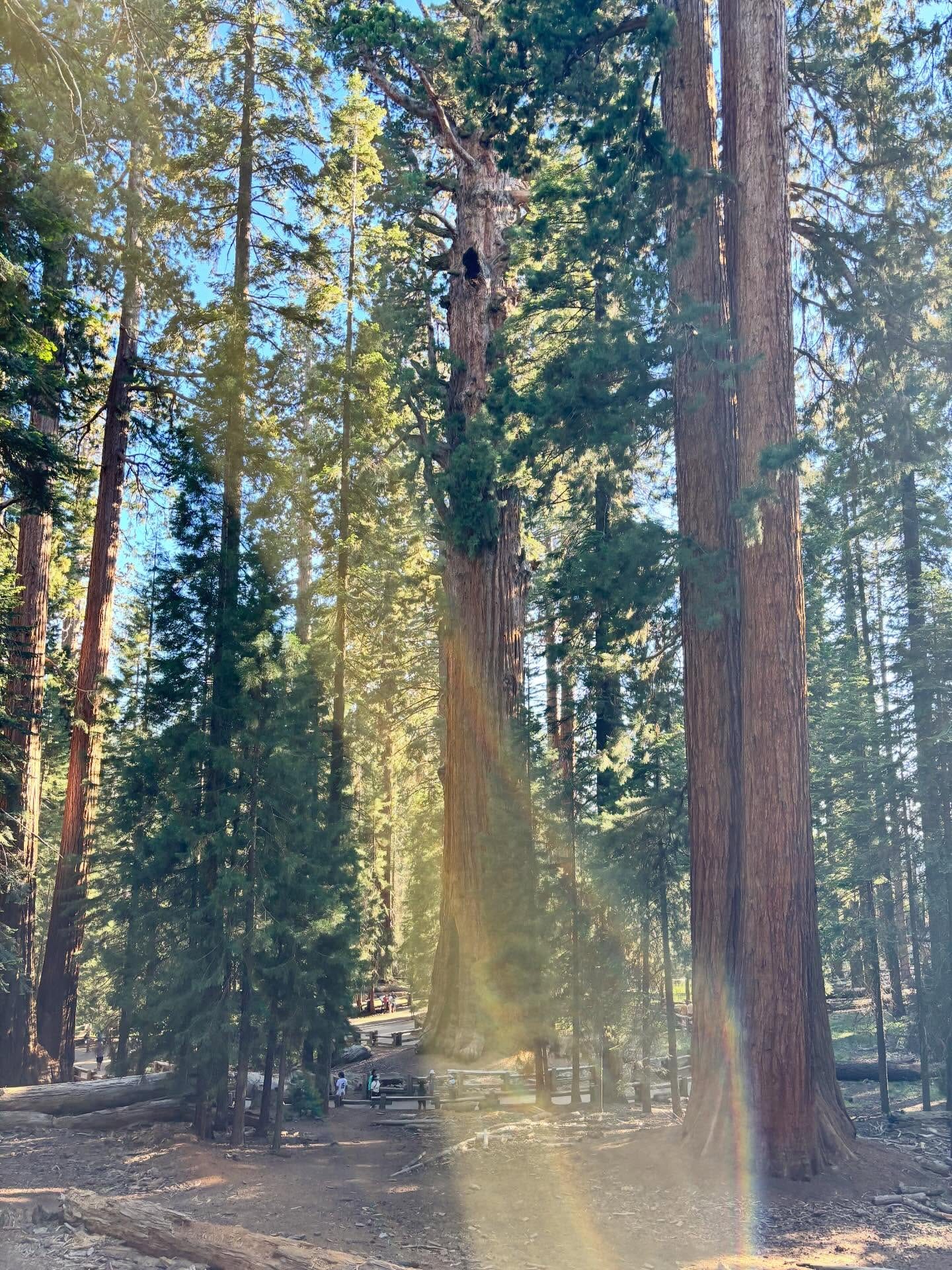
When we finally reached the trees, I was— well, honestly, gobsmacked is just the best word here. Pictures don’t do them justice. You see pictures on the internet giving you some idea of the scale, but you can’t understand what it feels like to experience it in person. Sometimes, we all need reminders of how small we really are in the grand scheme of things. And there’s nothing like a flock of big giant trees to put you in your place. The General Sherman Tree (pictured above) is the biggest tree by volume on Earth. That’s insane. It’s also estimated to be somewhere between 2,200 and 2,700 years old.
You think 250 years is a long time? This tree has seen everything. This tree has seen the foundation of the United States of America and every year after that, and you get the feeling that it was totally unmoved by it all. I have no idea how long these trees live, but it wouldn’t surprise me if they were here long after we’re all gone. Hopefully that’s true.
I’ve never been a big believer in the idea of a spiritual connection with nature. It’s the sort of thing that, when I hear people say it, I sort of roll my eyes a little bit. But having seen these trees up close, having reached out and touched them with my own hands, I… I might think differently now. I could spend days just walking around these trees, which seems crazy to say— I mean, they’re trees, after all. But they’re amazing. They’re beautiful. They’re enormous. They shock you into stunned silence at their sheer size.
America is big. Really, really big.
The next morning, as we all worked on our hotel breakfast in Tulare, the background noise of the television provided a stark contrast. Fox News (because I guess we were in the Fox News part of California) was clutching its collective pearls because four DSA-backed candidates had won their primaries in New York City. A suffering succotash of socialists was smashing into America.
It all felt so small because I realized that it’s all they’ve got. They’re clutching at something, anything, and screaming about the dangers of communism like it’s the 1950s; it’s what they’ve come up with. I almost laughed as I realized that Fox News has become what they spent decades railing against: just another corporate coastal media elite organization. Call me when the DSA is electing people in Peoria or Poughkeepsie.3 In the meantime, all of the shouting on television just felt so, so small.
III. Canyons
Utah makes so much sense when you go and see it in person. You drive down I-15 towards Saint George, and the way the mountains lie alongside the road so perfectly, so grey and red and mottled until they fade down into the perfect shade of green, seems like something out of a storybook. It makes sense to me that the first Mormon settlers to roll out of the Wasatch Range stopped, looked around and said, ‘This must be the place,’ and stayed there. (Granted, there’s a lot about the Mormon Church that I a. don’t know and b. doesn’t make sense to me and c. they don’t like to talk about all that much4, but I get the whole Utah part of it.)
We scored an Airbnb for a basecamp of sorts for the Utah portion of the trip. (We knocked off Death Valley— insanely hot and otherworldly) and had a pit stop in Vegas before we got to Utah, but once we got there, we tackled two of the canyons: Bryce Canyon National Park and Zion National Park.
One of the reasons that I loved this trip was that it allowed me to actually look around at some of these places a little more. I’d done Death Valley, Bryce and Zion as a kid. I was not the most athletic of kids and, honestly, probably didn’t appreciate any of those places as much as I should have back then. (We did try to fry an egg in Death Valley; I do remember that. We, if I recall, were unsuccessful.) This time around, I wanted to soak it a little bit. This was my mulligan. My ‘do it right this time’ moment. And that’s the weird thing: maybe everyone has those moments. Maybe the places you went on vacation as a kid just kind of stick in your brain, and you don’t really appreciate them as much as you should until you grow up and have kids of your own you can drag all over the country to these places.
Then, they too will grow up and remember.
That’s my hope, anyway.
Arriving in Utah meant that our first stop was Swig. (Yes, I’m being serious.) I still don’t know how to feel about the concept of a dirty soda. Soda is arguably dirty enough as it is, what with all the sugar and such, but when in Rome, etc. So I embraced the dirty soda in all its glory, and let’s just say that between all the extra flavoring and those damn mini chocolate chip cookies, I’m glad I don’t live in Utah because I would spend concerning amounts of money at that place.
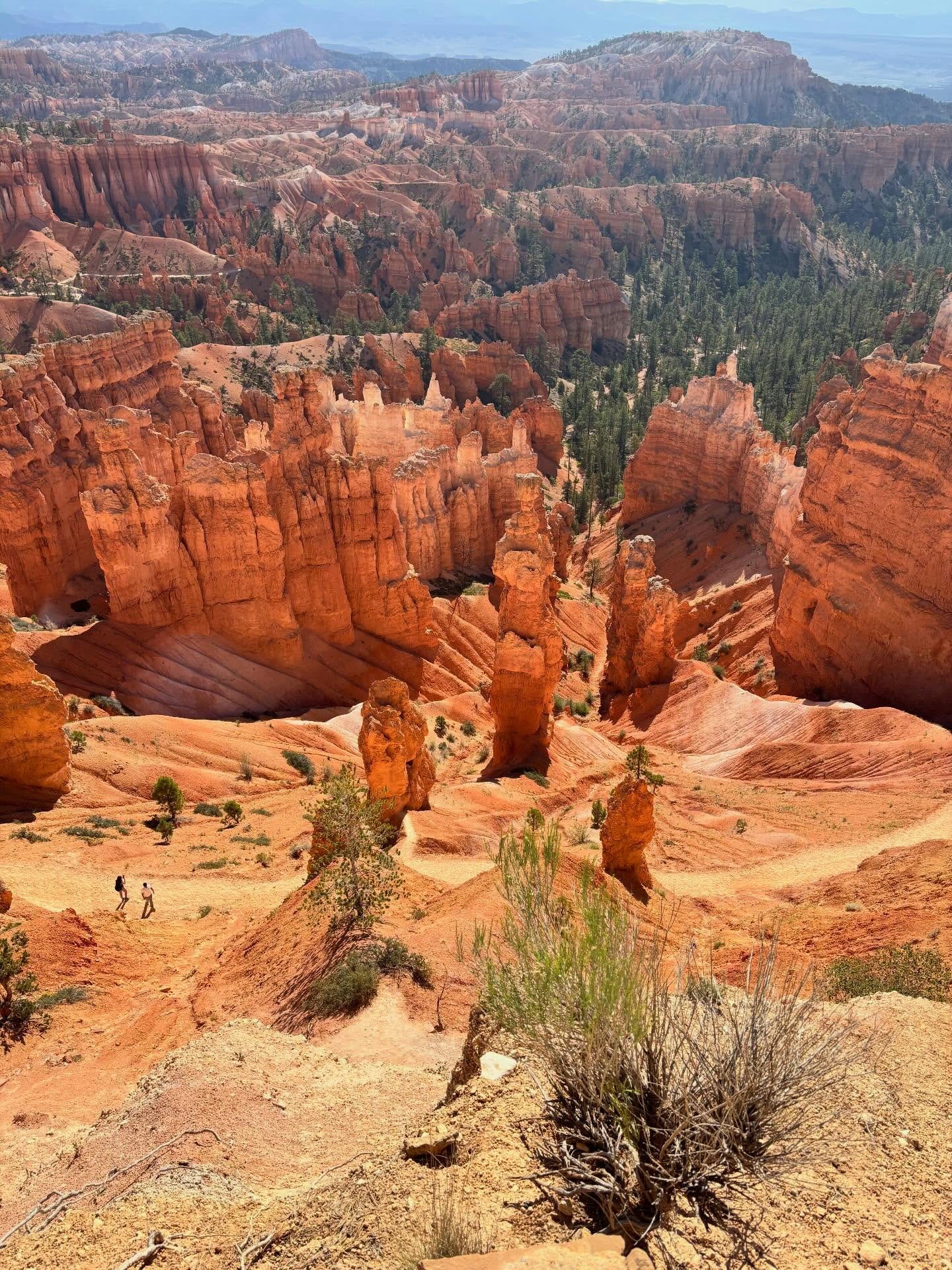
We tackled the Kolob Canyon section of Zion (which I had never been to before), and it wasn’t bad, but it kind of gave the Missus and me pause and made us think about how we’d like to tackle Bryce Canyon. We found some flat, easy walks along the rim that looked good, another one that had a waterfall and a cave or something, but, weirdly, got outvoted by the children who wanted to have an adventure and go down into the canyon. All four children enthusiastically endorsed the idea, despite being warned that they would have to walk back up again, and despite some protests and general dislike of the ‘walking back up again ’; they did it.
Bryce gets bigger the further you walk down into it— it fits the old ‘gradually, then suddenly’ type of vibe in that gradually you get deeper and deeper, and it gets bigger and bigger around you. Zion, in contrast, awes you into silence the deeper into the canyon you get.
The Grand Canyon lives up to its reputation, and you can hike down to the bottom and back out again. When they say that it’s the one place you can go that lives up to expectations, I think I would agree with that. Yosemite might be another. The sheer immensity of Zion is just another level to me. Everyone has probably seen the TikToks coming out of the tunnel on the Zion-Mt. Carmel highway and the sheer size and scale of what greets you does take your breath away. Zion might be the most beautiful place I’ve ever seen. I would go back tomorrow and do all the hikes and all the things. I would be a troubadour or a professional hobo or something if I could just get a chance to sit there, daily, and just take it all in. It’s that beautiful.
We didn’t do much in Zion: the crowds and the transportation logistics were a challenge, and we were getting to the end of our trip. The kids were getting hiked out, which is understandable. We did take the shuttle in and do the Riverside Walk to the entrance of The Narrows.
That was honestly the most trying hike. Kids will be kids, and my patience was limited, and it was a flat-ass, paved route for the most part, but the sheer amount of whining and complaining was astonishing. These were the same kids who voluntarily walked down into Bryce Canyon and back out again, right? Thankfully, all of that vanished as soon as they realized that the trail turned into the river at the entrance to the Narrows. Groans and complaints were replaced with smiles and adventure, and a core parenting memory ensued. And if you can’t go on vacation and accumulate a few core parenting memories, then why bother to go on vacation at all, quite honestly?
I did forget how much I love Utah. Honestly, it’s one of the most beautiful states in the country— whether it was the wildfire smoke or just the general magic of the desert, the sunsets were beautiful. It cooled down to a pleasant temperature every night. The stars in the night sky were bountiful, and it was quiet. The air felt cleaner, fresher— though whether that was a truck of the imagination or actually true, I don’t know. But alas, all good things must come to an end, so we went to the one place in America which might be the complete opposite of the beauty of nature and our national parks: Las Vegas.
They say the rise of sports betting has taken the bloom off the rose in Vegas, and it’s seen better days. I might be inclined to agree with that— the casino floors smelled like air conditioning, stale cigarettes, and broken dreams. The attractions were lacking— I miss the erupting volcano or the pirate ship fight at Treasure Island. The rise of online sex also means there’s a lack of those dude snapping flyers for assorted strip clubs and adult entertainment venues at you. (I saw one dude, whom my kids were blissfully unaware of.)
Also, I don’t know if you were aware of this, but trying to navigate the man-made canyons of various casinos on the Las Vegas Strip with four children isn’t exactly fun. Especially when they’re all hiked out and decide to walk at precisely one speed that is no one else’s speed. Lord, I needed a lot of patience that afternoon, but we killed some time, we went to the Flamingo and saw the flamingos, who were treated to some kind of thumping bass from a techno-rave concert nearby. Probably at the Vanderpump Hotel or something. (I am now old enough to proudly say that I don’t know what a Vanderpump is and I don’t intend to find out.)
We survived. We found our hotel for the night (I didn’t know hotels did the weird KFC/Pizza Hut combo thing, but we were treated to a Home2/Hampton combo thing with an excellent and much-needed pool). We got up ridiculously early to return the rental car— and discovered we had driven 1,784 miles over the course of ten days. Checked bags. Security. Found our gate, got our flight and made it back home to emerald green, and so much humidity. So, so much humidity.
IV. Bless This Mess

So what did ten days in a rental car with four kids teach me about America? I don’t know if I set out to learn anything about America, but I sure questioned my sanity a few times, and I know the Missus did too. But I do think it was a nice reminder that we all need from time to time— especially in these times: America is bigger than any one person.
Is it perfect? Far from it, but those geniuses 250 years ago, flawed though we may consider them in the light of modern times and values, did something that had never been done before in world history up until then. They founded a country based on an idea. They knew it was flawed at birth, with ugly moral compromises they made to stick together in the face of what they saw as a greater tyranny at the time. But as the kids today say, they cooked with this: “We the people of the United States, in order to form a more perfect union…”
What greater sentence, what greater opening line has a country on this planet than that— find it for me; I’ll wait. The genius of that line is that the work is never finished. The striving continues down the generations again and again, Americans have to find and work for that more perfect union.
We aren’t there yet. We may never get there— it’s not a zen state. It’s not something you achieve and then rest from your labors. You have to pick up the task again and again, generation after generation, and keep building. We seem impossibly far away most days. But that charge still echoes down through the generations: do the work.
Do enough of it, and who knows what will happen.
Another thing I tend to make me roll my eyes a little bit is those podcast bros that talk about leadership principles and things like that in lieu of anything else remotely interesting. I don’t roll my eyes at all of it— I’ve read some Jocko Wilink and Simon Sinek, but some of it is definitely a little cringe. But if I do have one emerging principle, it might be this: do enough little things and do them right and eventually you’ll have a big thing on your hands.
It seems impossibly bleak some days, but if every one of us just figured out one little thing we could do every day to make things a little better around here. Then, eventually, we’ll have a big thing on our hands.
And if a ten-day voyage across the American West taught me anything, it’s this:
America is big. Really, really big.
It’s easy to forget that sometimes.
So, Happy Birthday, America. You’re a big, beautiful mess a lot of the time. Whatever you believe or don’t believe, whether it’s a higher power or nothing at all, I sure hope someone continues to bless this mess.
After all, we could use all the help we can get down here.
~
Yes, there’s photographic evidence of this buried somewhere in the family photo albums. No, I will not be sharing for obvious, cringe-related reasons.
How big is Los Angeles? There was a warehouse fire somewhere that the local news was nattering about, with potential for toxic fumes and air quality issues. In any other city, I might have been mildly concerned. In Los Angeles, it felt like a news story from another country— but in the same city. That’s how big the place is.
Look at how AOC has operated before you get all verklempt about a sudden rash of DSA candidates winning Democratic primaries. The smart ones will learn how the system works and how best to advocate for what they want. The not-so-smart ones will probably have the electoral survivability of a snowball in hell. Either way, not going to wring my hands about this until they start electing folks in places that are decidedly not NYC.
Take your pick from this list, but: “From 1852 to 1978, church policy excluded men of Black African descent from ordination to the priesthood. During the same period, Black men and women were not allowed to participate in temple endowment or sealing ordinances.” Yes, you read that right. 1978.