
Streetcar Ghosts
How History Can Teach Us That Nothing Is Immutable

When Abundance hit the bookshelves last year, it sparked an immediate policy-wonk debate in Democratic circles, but the underlying points of the book (and others like it) remain hard to refute: why can’t we build anything anymore? Plenty of people dream about things like high-speed trains. This map pops up on the internet now and again, like a Gen Z rail aficionado’s dream:
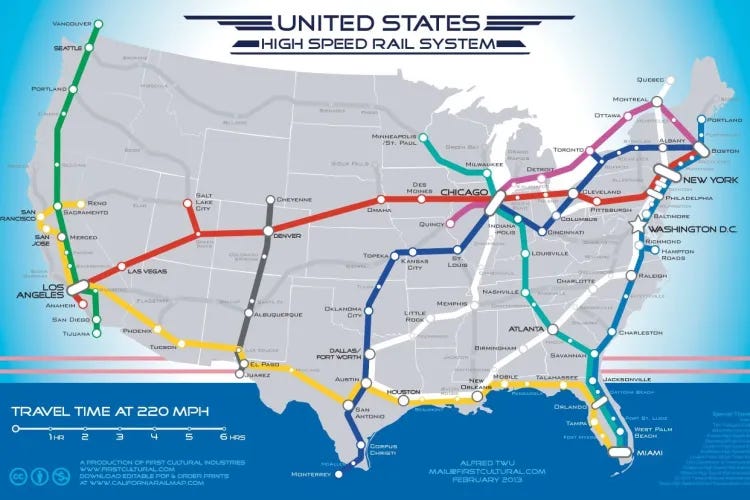
And it’s practically a meme at this point, but for every one pushing that dream, ten people are like “but we have planes?” That’s really the underlying problem to any number of things at this point: people always have a reason not to do things— it’s just baked in at this point. What we really need to get back to is a cultural attitude of ‘why not?’ Happily, history demonstrates that nothing is immutable— people just did things back then. And it’s not just in faraway places or between the dusty pages of textbooks that bore far too many people to death. It’s all around us.
Johnson County keeps flirting with the idea of restoring passenger service on the old CRANDIC line. It seems to happen about once a decade, and the last go-round seemed to hold some promise. Pop-Up Metro offered class D, battery-propelled light metro trains that could run on existing track and apparently came with platform and maintenance infrastructure built in1, so communities could test potential ridership rather than worrying about infrastructure. It advanced quite a bit further than it usually does, before CRANDIC put paid to the notion altogether. (Personally, I think it lacked ambition: passenger rail between North Liberty and Iowa City would be nice, but the real prize would be service between Iowa City and Cedar Rapids again, especially as the CRANDIC line runs past the Cedar Rapids Airport, Veterans Memorial Stadium, and does a loop around downtown CR.)
If you can’t get the CRANDIC line back— and honestly, barring a change of ownership to one more passenger-friendly, freight contracts will probably always be a barrier to getting passenger service back. From a practical point of view, consolidating and expanding bus service across the county seems like the obvious and probably more cost-effective way to expand transit options. But there’s one option if you’re looking for an intracounty transit that might be worth kicking the tires on if you keep it simple enough: streetcars
Now, hear me out. The modern ‘streetcar’ seems closer to light rail than the ‘clang-clang goes the trolley’ you’re probably thinking of. Kansas City already has one, and Omaha is starting to build its own to start service in 2028. But more importantly, there’s historical precedent for streetcars in the county— back when Iowa City had a far lower population than it does now.
The rail history of Iowa City is a fascinating rabbit hole to fall down. There’s more than just the streetcar line to talk about, but specifically, the Iowa City Electric Railway began as a brainchild of James H. Maggard, who proposed a new city addition, ‘Rundell’, between Iowa City and what was then East Iowa City, that a streetcar franchise would service to take people to downtown.
There’s a ton of knowledge in that sentence that’s worth unpacking.
Yes, James H. Maggard is presumably who Maggard Street2 is named after. (Our Iowa Heritage calls him ‘the Mark Twain of writers on engineering,’ and I have no idea how true that is or not, but I found a copy of ‘Rough and Tumble Engineering’ by James H. Maggard over on Project Gutenberg. The title, at least, seems fun.)
The ‘Rundell’ addition is, yes, centered around where Rundell Street is today.
East Iowa City was more of a surprise, but it makes sense, after a fashion. Cities, after all, grow organically and not necessarily in a nice and orderly fashion. So, for a while, there was a separate town called East Iowa City. From what I can tell, it was roughly everything between Seventh Avenue and First Avenue south of Court Street to the railroad tracks.
The streetcar era in Iowa City lasted for two decades before the automobile reigned supreme and the flexibility of the bus won out over the fixed nature of the streetcar, but what’s interesting is where it ran while it was in service, and how you can spot where it ran even today. The most obvious example is the start, Rundell Street:
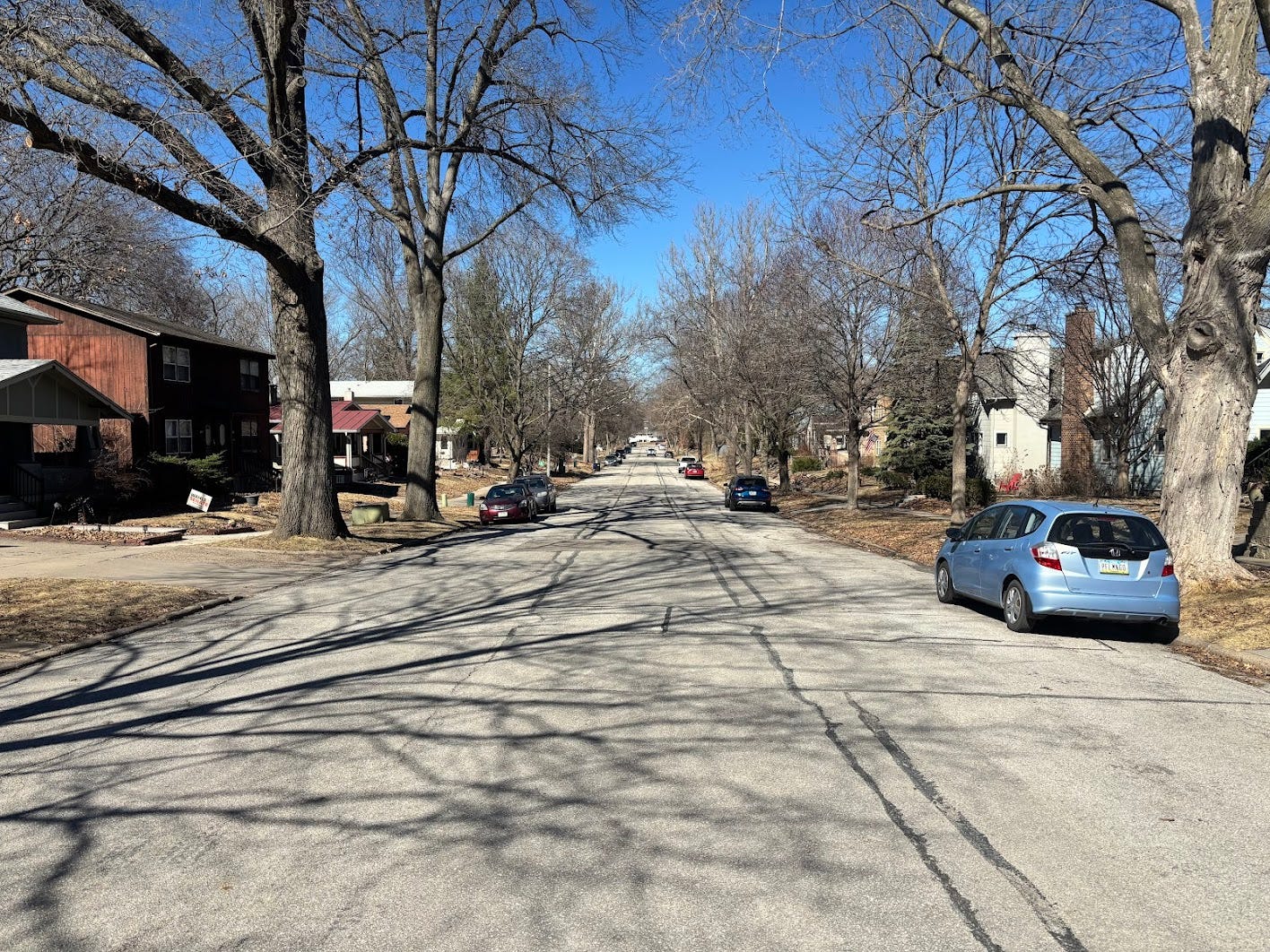
Now, do I know that the marks on the asphalt are where the track itself used to run? No, I don’t. It sure seems that way to me, but what gives streetcar streets like this away is the width. Rundell is the widest street in that neighborhood by far, and it’s very noticeable. (From what I can find, the streetcar started at about where Sheridan Avenue is today and then ran down Rundell, left onto Muscatine, and then left again onto Burlington.)
Burlington from Muscatine to the top of the hill is harder to imagine, as it seems narrower- and that might have changed over time, I don’t know— but the original route turned on Johnson Street and then down College Street:
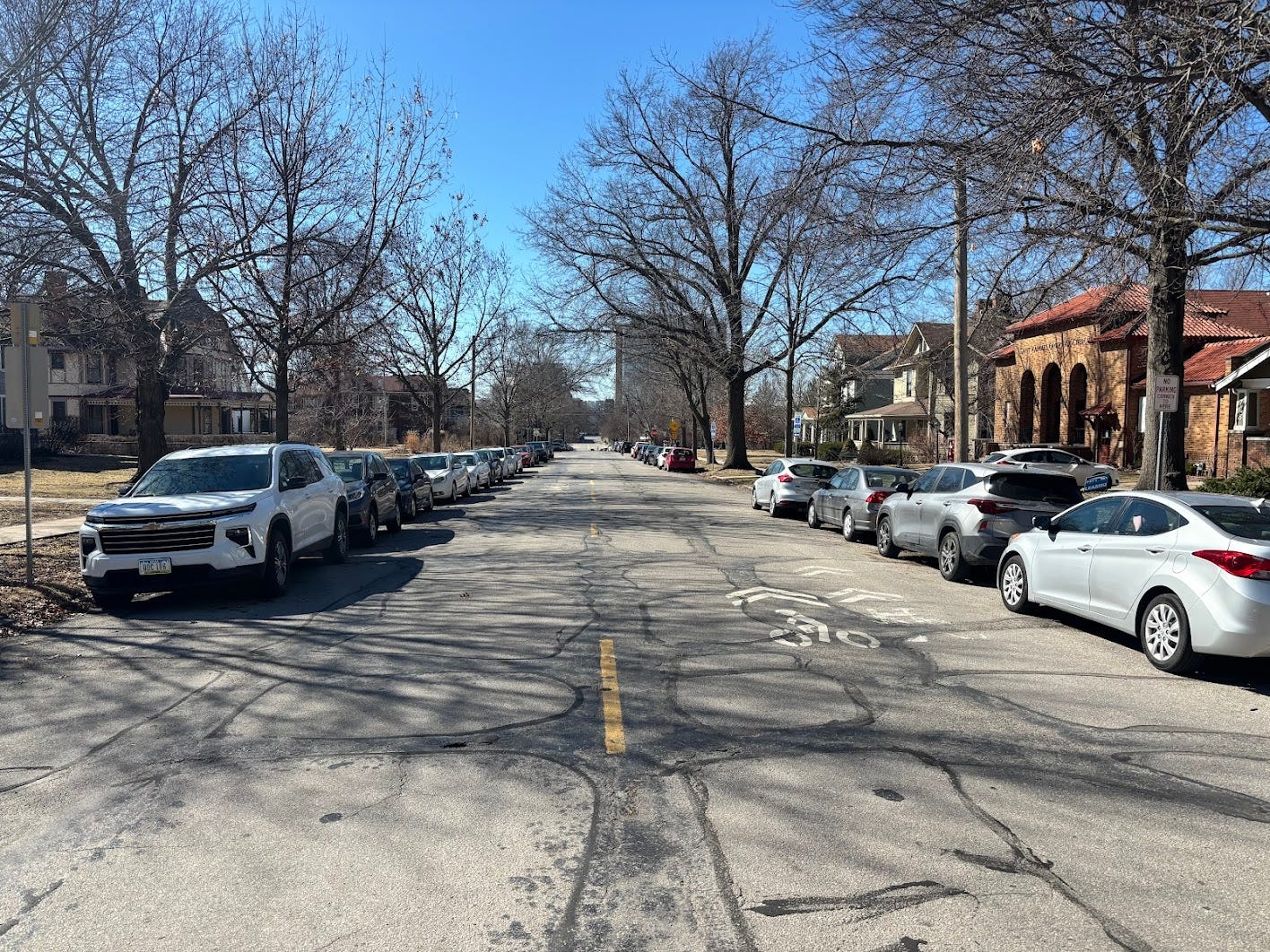
Granted, this was not right at Johnson Street, so it wasn’t quite on the route— but you get the idea. There are signs here- the width of the street alone makes it make sense.
At its height, the streetcar ran down Dodge Street (from the Conklin Lane area) to Church, over on Church to Dubuque, and then down Dubuque to College Street, where it intersected with the original Rundell to Clinton map. A spur down Clinton to Wright Street linked it with the main rail line. The surprising line, to me, was this one:
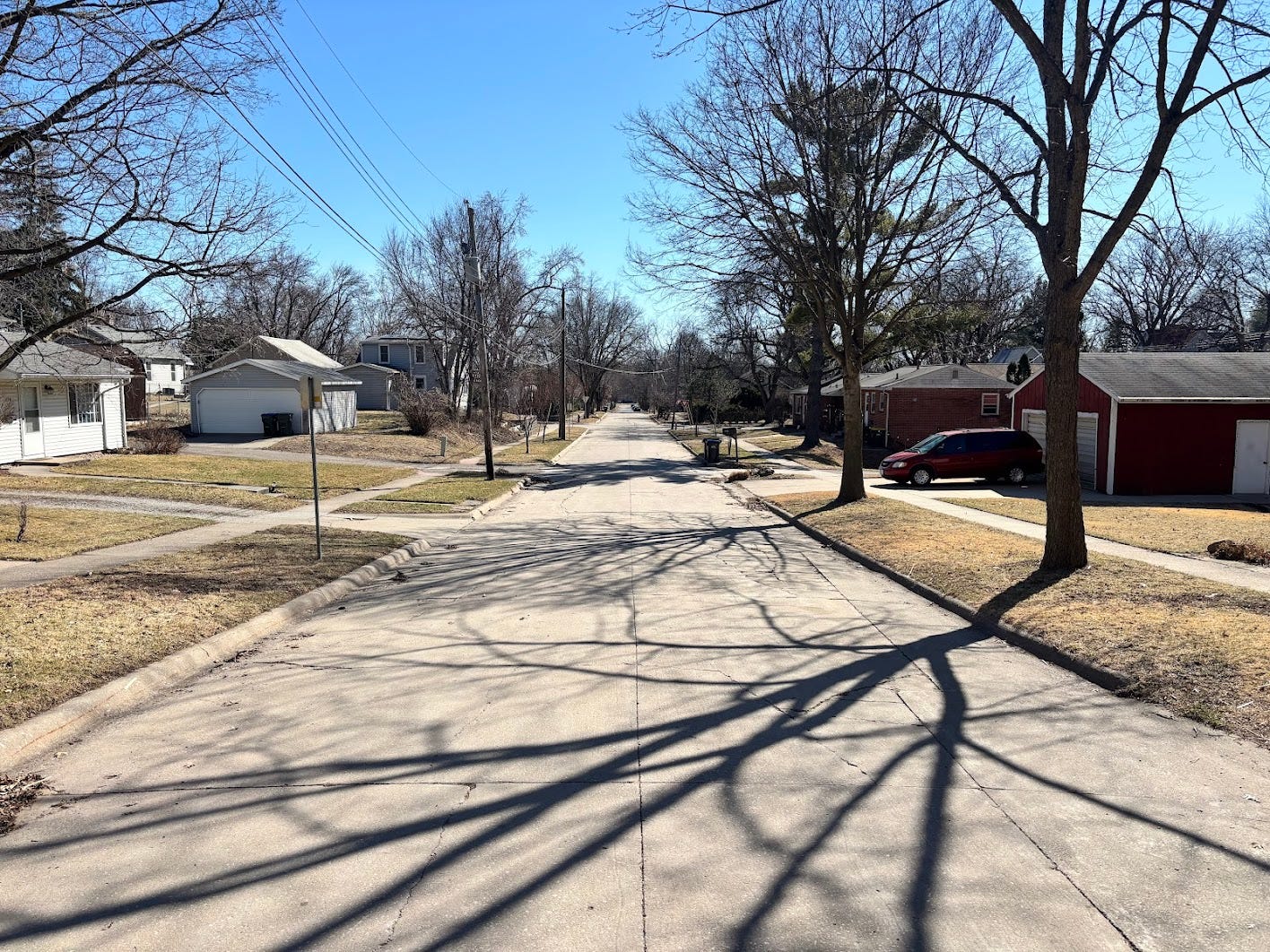
This is Center Street. It’s tucked away on the east side of Iowa City, west of Hickory Hill Park and south of Oakland Cemetery. This is more or less where the streetcar ended on the map, and it’s harder to see here, but not impossible. Jump over to Reno Street, one block over, and you see a definite difference in the width. It seems like a surprising place to have a streetcar line unless you consider what the primary purpose of these vehicles was: getting people from neighborhoods to work downtown. In that case, the line down Center Street to Bloomington and then Governor to Jefferson and then Van Buren to Washington (a nice little zigzag through the neighborhoods) makes perfect sense.
The streetcar made it across the river, thanks to the then newly built Park Road Bridge and the Manville Addition (now known as Manville Heights). Over there, it terminated at the intersection of Ferson and River Street. This is Ferson:
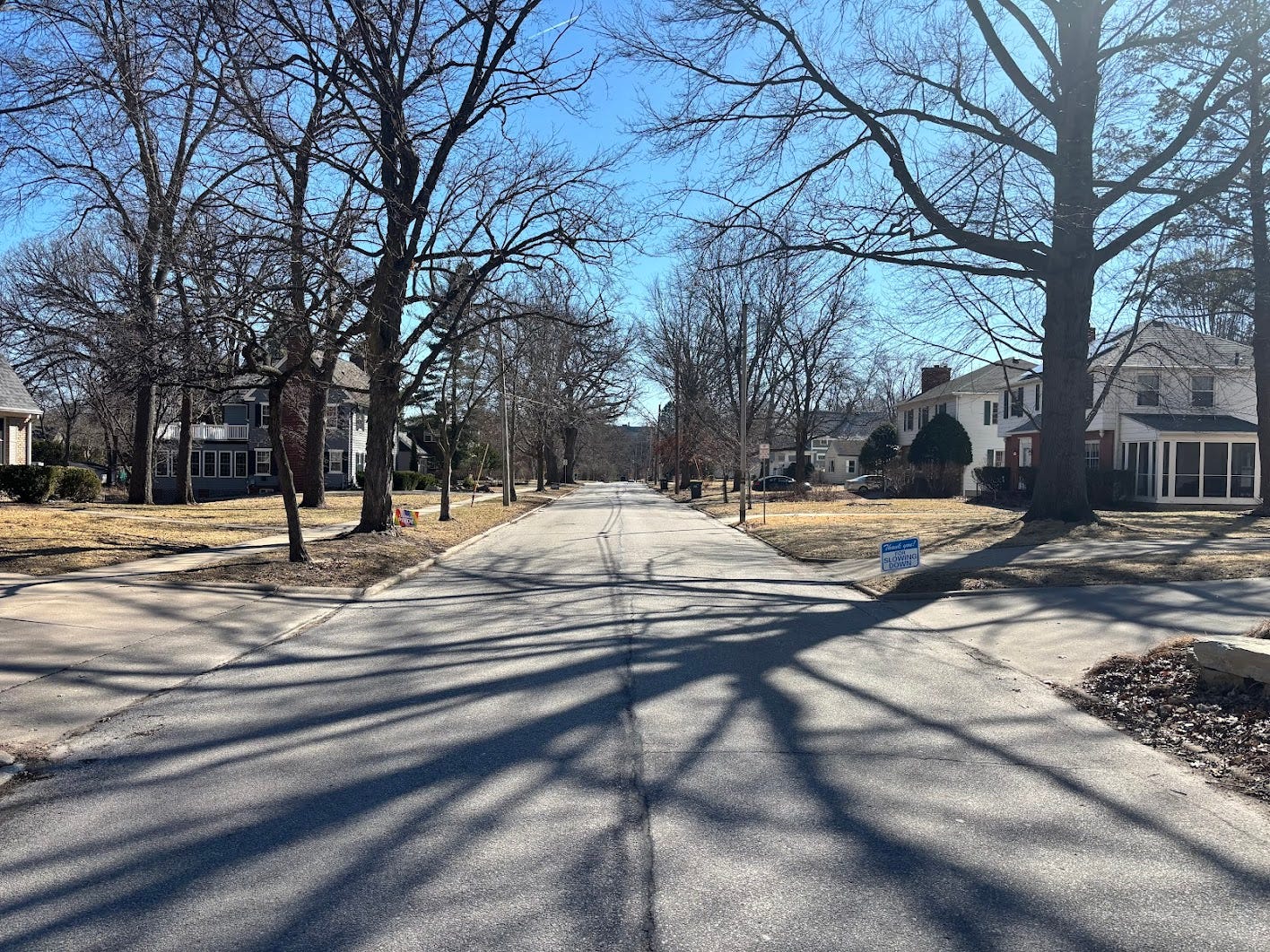
If you squint a little, you can sort of imagine it here as well. Ferson weirdly narrows as it runs alongside the old University Marching band field, but then widens back out again into this.
Could you run a streetcar from the center of Tiffin straight down the middle of the Coralville Strip and into downtown Iowa City? Sure. Go up 965 into North Liberty and keep things simple, and move them in straight lines, and it might even work. How much ridership will there be? I don’t know. How fiscally viable is it in the current regulatory environment? I don’t know. But if the debate about abundance teaches us anything, it’s that we have to build the future we want. Whether that’s rapid bus transit all over the county, a return to passenger rail, or something else entirely, I don’t know.
But history is with us every day. It’s on the streets we drive down every day. If you hate the way we zone or the houses we build, or the lack of color in our built environment, or how square and monotone everything is becoming, history is not immutable. We don’t have to be trapped in the present.
I didn’t start this post intending to advocate for some kind of alternative transport method locally. I do think bringing back actual passenger service on the CRANDIC line- especially if you can do so on the existing track is an idea worth exploring. I think the more practical notion is getting bus service to North Liberty and Tiffin in a meaningful way.
The more I read about the history of Iowa City’s streetcars, the more fascinated I become. There were so many streets that I had driven down hundreds, if not thousands of times, and I never would have thought that a streetcar would have run down them at all. There are so many things that we take for granted every day that are, in fact, ghosts of the past, hidden in plain sight, unless you know where to look.
~
Another great example of how history is all around us, even now. A recent visit to Press Coffee Shop and a scroll through a random ‘Iowa City Through The Years’ book revealed to me that there used to be a Tofting Farm south of town, roughly, I’m guessing, where Tofting Avenue and Tofting Circle are today. Similarly, Dunlap Court is named for the family that sold the farmland that eventually created City High School and what used to be Hoover Elementary School— the original house that went with the farm is still there.
Some more rail history and the Eastside sprinkled in here!
https://sway.cloud.microsoft/bVWml8MnPR8oQ8dI